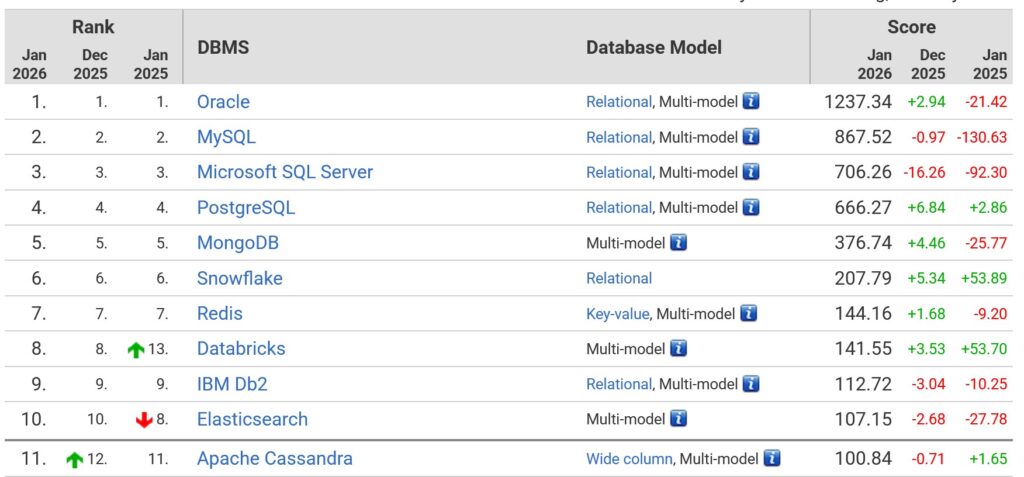
Top 10 Most Used RDBMS Databases in 2025

Based on the input conditions, we created a ranking of the most used databases for 2025 with AI.Inpust parameters :
- DB-Engines popularity,
- Developer surveys ,
- Enterprise adoption patterns ,
- cloud provider usage,
- used technology trends in 2025
Comparing relational databases is increasingly complex. Some systems are designed for large-scale enterprise architectures, others are optimized for cloud-native environments, while many thrive in open-source ecosystems. Although direct comparison is not always straightforward, this article focuses on the most widely used relational database management systems (RDBMS) and highlights overall usage according our knowledge and statistics , popularity trends, and adoption patterns that define the database landscape in 2025.
Open‑source RDBMS dominate total deployment
PostgreSQL and MySQL lead due to:
- Popularity in SaaS and web applications
- Low cost and easy onboarding
- Massive developer communities
- Strong cloud support
Enterprise RDBMS dominate mission‑critical workload
Oracle Database and Microsoft SQL Server remain essential for:
- Financial systems
- Telecom infrastructure
- Government platforms
- ERP and legacy systems
Cloud‑native RDBMS are the fastest‑growing segmen
Platforms like Amazon Aurora, Google AlloyDB, and Snowflake grow rapidly thanks to:
- Fully managed operations
- High availability
- Pay‑as‑you‑go pricing
SQLite is the most deployed database on Eart
It powers:
- Browsers
- IoT devices
- Edge computing
SAP HANA and IBM Db2 remain strong in specialized sector
These systems thrive in:
- ERP workloads
- Mainframe and financial system
1. Oracle Database
Best for: Enterprise, finance, telecom, government
Oracle Database is a powerful, reliable, and secure RDBMS built for large-scale and mission-critical environments. Its advanced clustering, security, and automation features make it a leading choice for organizations that require maximum performance, availability, and enterprise-level data management.

Why it leads:
- Elite OLTP/OLAP performance
- Autonomous Database automation
- Industry‑leading security
- Multi‑model support
- Deep enterprise adoption
2. MySQL
Best for: Web apps, SaaS, startups.
MySQL is compatible and alternative with MariaDB

Why it remains dominant:
- Powers millions of websites
- Cloud‑optimized variants (Aurora)
- Easy to learn & operate
3. Microsoft SQL Server
Best for: Enterprise, BI, hybrid cloud and Enterprise systems.
Microsoft SQL Server is a relational database management system (RDBMS) developed by Microsoft for storing, managing, and analyzing structured data. It is widely used in enterprise applications and is tightly integrated with the Microsoft ecosystem.

Why it’s widely used:
- CTight Azure & Power BI integration
- Strong analytics features
- Enterprise‑grade security
4. PostgreSQL
Best for: Modern EE apps, cloud‑native workloads
Postgres is OpenSource database solution with all necessary features and architectures for robus Entrerprise solution .

Why it’s the fastest‑growing RDBMS:
- Advanced open‑source SQL engine
- Extensible (PostGIS, Timescale, pgVector)
- Strong cloud support
5. Snowflake
Best for: Analytics, BI, Data warehousing and business intelligence, Advanced analytics and reporting , Data engineering and ELT pipelines , Data sharing and collaboration, Machine learning data preparation

Why it’s exploding in popularity:
- Cloud‑native architecture
- Compute/storage separation
- Multi‑cloud support
6. MariaDB
Best for: Open‑source enterprise workloads, Web applications, E-commerce platforms, Content management system.
A powerful, open-source alternative to MySQL that offers improved performance, flexibility, and modern features while remaining easy to use and cost-effective. It is widely adopted in production systems where reliability and openness are priorities.

Why it’s widely used:
- Drop‑in MySQL replacement
Columnar & distributed SQL - Strong EU adoption
7. IBM DB2
Best for: Banking, insurance, mainframes, IBM DB2 is a enterprise-grade database known for its reliability, performance, and automation. It is well suited for organizations that need secure, scalable, and mission-critical data management, especially in large or regulated environments.

Why it remains relevant:
- High‑performance OLTP
- Strong security & auditing
8. SAP HANA
Best for: Large-scale data processing, Enterprise Resource Planning (ERP), Real-time business intelligence and reporting, Financial planning and analysis and Supply chain and customer analytics.
SAP S/4HANA is Most Popular App Using SAP HANA.
SAP HANA is a high-performance, enterprise-grade in-memory database that enables real-time processing and analytics on massive datasets. Its ability to combine transactions and analytics in one platform makes it a powerful choice for organizations running SAP-centric, data-intensive, and mission-critical applications.

Why it’s widely used:
- Core of SAP S/4HANA
- In‑memory performance
9. Amazon Aurora
Best for: Cloud‑native apps, SaaS. Amazon Aurora delivers enterprise-grade reliability, performance, and scalability while maintaining the familiarity of open-source relational databases—all as a fully managed cloud service. It’s a strong choice for applications that have outgrown traditional databases but still rely on relational data models.
Cloud-native scalability
Compatibility with MySQL or PostgreSQL

Why it’s growing fast:
- 3–5× faster than MySQL/PostgreSQL
- Fully managed
- Serverless auto‑scaling
10. SQLite
Best for: SQLite’s best features are its simplicity, portability, reliability, and zero-administration design. It’s not meant to replace large client-server databases, but for embedded, mobile, desktop, and local storage use cases, it’s one of the best solutions available.

Why it’s the most deployed DB on Earth:
- Embedded in billions of devices
- Zero‑config & lightweigh
| 1. PostgreSQL will overtake MySQL in more enterprise workloads | |
| Its extensibility, cloud support, and vector‑search capabilities make it the top choice for modern applications. | |
| 2. Cloud‑native RDBMS will grow faster than traditional on‑prem systems | |
| Aurora, AlloyDB, Azure SQL, and Snowflake will continue to outpace legacy deployments as companies accelerate cloud migration. | |
| 3. AI‑integrated SQL engines will become mainstream | |
| Expect more databases to add: Built‑in vector indexes AI‑assisted query optimization Native ML inference capabilities | |
| 4. Oracle and SQL Server will remain dominant in regulated industries | |
| Compliance, security, and legacy investments will keep them entrenched in finance, government, and telecom. | |
| 5. SQLite usage will surge due to IoT and edge computing growth | |
| Billions of new devices will continue to embed SQLite as the default local data engine. | |
| 6. Hybrid architectures will become the norm | |
| Companies will increasingly combine: Cloud‑native RDBMS On‑prem enterprise systems Edge‑embedded databases This hybrid approach will define the next generation of data infrastructure |